
The Hardest Bolt First: A Lesson in Business Systems
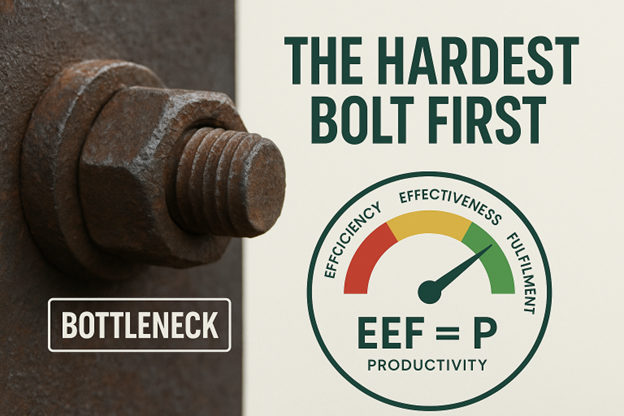
There’s an old mechanic’s rule I learned long before I ever thought about enterprise systems or diagnostics:
Always remove the hardest bolt first.
When you’re pulling off a transmission pan, it’s tempting to start with the easy ones — the bolts you can see, reach, and turn without effort. But any experienced tech will tell you: the real trouble comes when you save that one stubborn bolt for last. By then, you’ve boxed yourself in. The pan’s sagging, fluid’s dripping, your angles are gone — and you end up reassembling half of what you just did just to reach that one holdout.
It’s a mess you only need to experience once to learn the rule:
Find the hardest bolt first. Face it early. The rest will go smoothly.
From Wrenches to Workflows
The same rule applies to enterprise improvement and productivity systems.
In business, “bolts” are those stubborn process constraints, the bottleneck approvals, outdated data systems, or cross-department frictions that quietly hold everything together just enough to be a pain to remove.
Leaders often start their improvement journey by tightening up the “easy bolts”:
- A quick dashboard refresh.
- A new meeting cadence.
- A feel-good culture initiative.
They make the system look cleaner but never quite fix what’s binding it. Meanwhile, the toughest constraint, the one no one wants to touch, still holds the organization back.
The EEF = P Lesson
At Kelcraft, we measure productivity as Efficiency × Effectiveness × Fulfillment. It’s not a sum, but a product. And the “hardest bolt” lives where one of those three factors drops toward zero.
- Efficiency Bolt: maybe it’s an outdated tool or redundant workflow no one has time to rebuild.
- Effectiveness Bolt: maybe the team doesn’t have the right data or direction to execute.
- Fulfillment Bolt: maybe morale is so low that no initiative truly takes hold.
Tackling the hardest bolt first often means confronting the root constraint that’s been avoided for years. It’s uncomfortable, but it’s also where exponential productivity gains live.
Practical Example
One facilities team I worked with kept chasing efficiency wins; faster ticket closures, tighter schedules, yet their actual output didn’t improve.
The real “hard bolt”? Misalignment between their maintenance data and purchasing systems. Every part request had to be re-entered manually. Nobody wanted to touch that integration because “it’s complicated.”
Once we addressed that bolt, the messy system interface no one owned; Efficiency, Effectiveness, and Fulfillment all lifted together. Techs spent less time typing, more time fixing. Supervisors trusted the data. People took pride again.
Why This Matters
In every organization, the hardest bolt has the best value. Remove it early, and your entire system comes free with ease. Avoid it, and your people end up resurfacing the same problems again and again.
Improvement, like repair, is physical. You can feel when the system moves freely.
That’s the moment when productivity stops being a grind and starts to flow.
Takeaway:
Next time you diagnose a workflow or a department, be very cautious of “Quick Wins” – they only last until you get to the tough nut.
Find the bolt that everyone avoids — the process no one owns, the tool nobody trusts, the conversation leadership keeps postponing.
Because once that one is out, the rest will come loose with ease.
Author-Cort Keller
November 2, 2025